
APAA e-Newsletter (Issue No. 53, June 2026)
Korea Introduces AI Basic Act to Promote Innovation and Trustworthy AI Governance
John W. Chung, Y.P.Lee, Mock & Partners (The Republic of Korea)
The Republic of Korea has enacted the “Basic Act on the Advancement and Establishment of Trust of AI” (commonly referred to as the “AI Basic Act”), establishing one of Asia’s first comprehensive legal frameworks dedicated to artificial intelligence. The AI Basic Act took effect on January 22, 2026, with a one-year grace period.
The AI Basic Act is designed to foster the growth of AI technologies and industries while simultaneously building a reliable and human-centered AI ecosystem. The legislation reflects Korea’s broader strategy to strengthen global competitiveness in AI while addressing increasing concerns regarding transparency, safety, and accountability.
A key aspect of the AI Basic Act is its dual-track approach combining industrial promotion and regulatory oversight. On one hand, the Korean government plans to strengthen AI research, advance computing infrastructure, cultivate skilled talent, and promote commercialization of AI technologies. On the other hand, the legislation introduces governance measures intended to reduce risks associated with advanced AI systems. Key aspects are summarized in the table below.
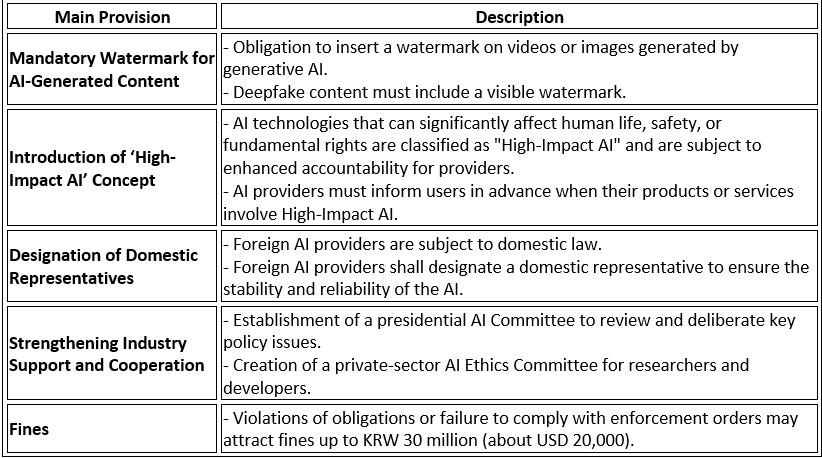
The AI Basic Act places particular emphasis on “High-Impact AI” systems, which may significantly affect individuals’ rights, safety, or social outcomes. Operators of such systems may be subject to obligations relating to risk management, transparency, reliability verification, and user protection. The AI Basic Act also requires that AI-generated content must carry watermarks.
The AI Basic Act is expected to have substantial practical implications for technology companies, platform operators, and electronics manufacturers. The legislation also signals that AI compliance and governance are becoming important considerations alongside traditional IP and technology strategies. Foreign companies in Korea may need to reassess their internal AI governance structures such as data handling policies during the one-year grace period.