
APAA e-Newsletter (Issue No. 53, June 2026)
India – What’s in the Manner of Use? Quite a Lot, Says the Lotus Splash Judgment
Vaibavi S G - Vutts & Associates LLP (India)
Introduction
The recent judgment of the Delhi High Court in Lotus Herbals Private Limited v. DPKA Universal Consumer Ventures Private Limited & Ors. [1] marks another significant development in Indian trademark jurisprudence, particularly on the recurring question of when a term is being used merely as a descriptor and when it crosses the line into trademark use. The Division Bench judgment in this case, reiterates that the defence of descriptive use cannot become a shield for the commercial appropriation of another’s trademark.
The dispute arose between Lotus Herbals Pvt. Ltd., the proprietor of the well-known “LOTUS” trademarks in relation to cosmetic and skincare products, and the Respondents, who marketed and sold a face cleanser under the term/mark “Lotus Splash” as part of their umbrella brand “82°E.” Aggrieved by the use of the impugned mark, the Appellant instituted an infringement suit alleging violation of their statutory and common law rights in the “LOTUS” marks. The fundamental argument of the Respondents was that the word “Lotus” was used as the product contained Lotus extracts, and therefore the expression, fell within the statutory protection available for descriptive use under Section 30(2)(a) and Section 35 of the Trade Marks Act, 1999 (“Act”).
While the Ld. Single Judge observed that a prima facie likelihood of confusion existed between the competing marks, interim injunctive relief was nevertheless denied on the ground that the Respondents’ use was protected under the exceptions carved out in the Act, with respect to descriptive use. On appeal, however, the Division Bench reversed this finding and undertook a detailed examination of the distinction between descriptive use and use of a mark in a trademark sense.
Distinguishing Descriptive Use from Trademark Use
One of the most important aspects of the judgment is the Court’s analysis of what truly constitutes use as a mere descriptor. The Division Bench clarified that the determination of whether a term is being used descriptor or in a trademark sense must involve the manner of use i.e., the examination of the nature, placement, prominence, and overall commercial impression created by the impugned term.
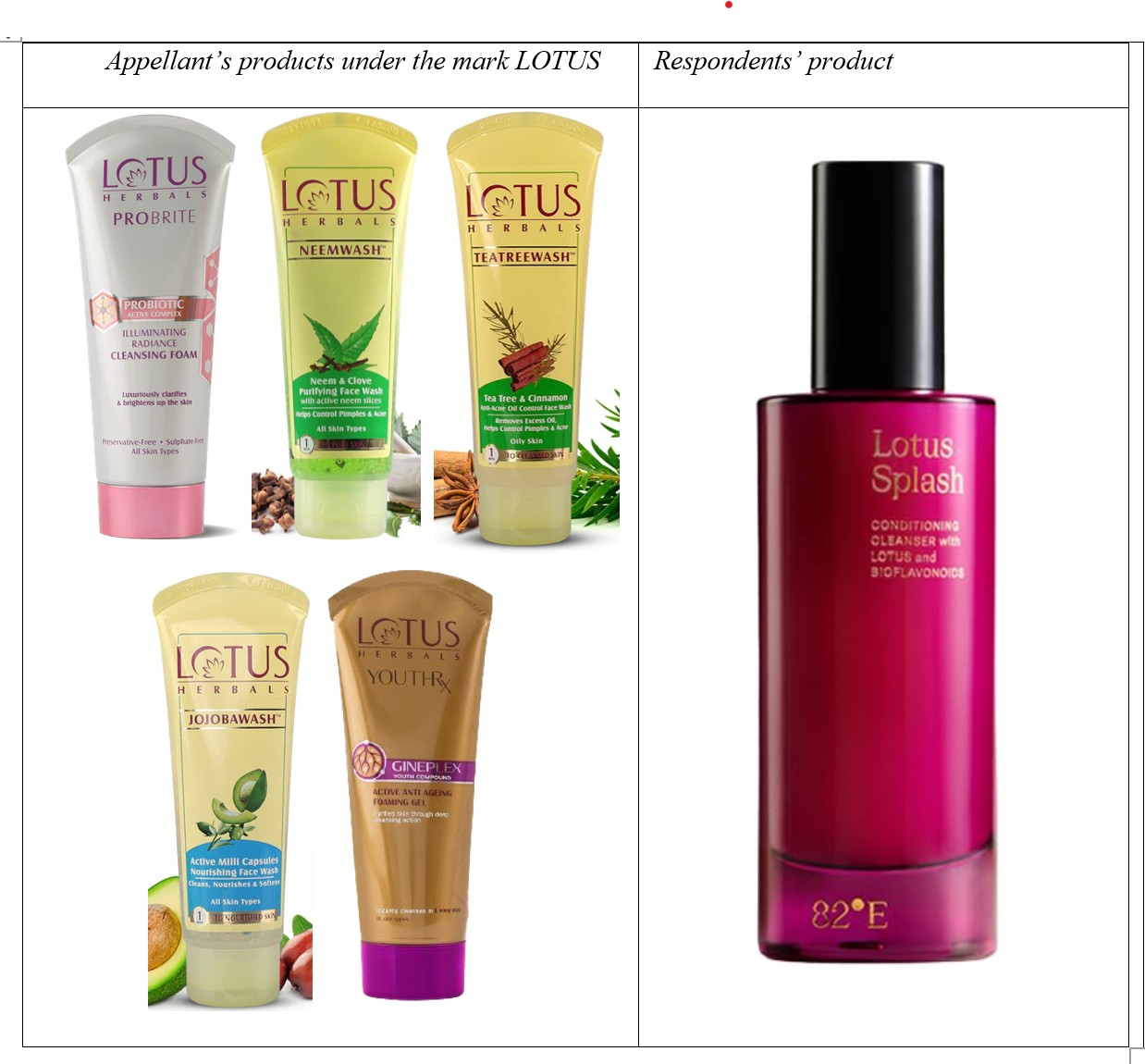
Because in trademark law, packaging often speaks first, the competing products are reproduced below to better appreciate the contentions of the parties:
The following considerations weighed significantly with the Division Bench:
- Placement and Prominence of the Expression: The Division Bench carefully considered how the expression “Lotus Splash” was used on the product packaging, including the visual prominence, font size and location of “Lotus Splash”, and determined that it was not used casually or incidentally within descriptive text, but in a manner consistent with branding and source identification. The Court found that the expression was in a dominant position and capable of immediately attracting the attention of the consumer and therefore acting as a trademark or sub-brand.
- Prominence of “Lotus Splash” over the house mark “82°E”: The Division Bench noted that the expression “Lotus Splash” was displayed on the packaging much more prominently than the umbrella brand “82°E”, where “82°E” was only present on the bottom of the packaging. The visual prominence afforded to the impugned term indicated that it was used as a source identifier or sub-brand, and not simply as a descriptive reference. The Division Bench also relied upon the decisions in Hem Corporation Pvt. Ltd. v. ITC Ltd. [2] and Piruz Khambata & Anr. v. Soex India Pvt. & Ors. [3], to reiterate the principle that whether an expression is used descriptively or in a trade mark sense, depends on the manner of its commercial use, including whether it functions as a mark or a sub-brand.
- Separate use of descriptive language: The Division Bench noted that the Respondents had already separately described the product as a “conditioning cleanser with lotus and bioflavonoids.” This, according to the Court, constituted the actual descriptive reference to the product’s ingredients and characteristics. Consequently, the separate and prominent use of “Lotus Splash” could not be justified as descriptive use.
- Digital advertising and keyword purchases: The Respondents’ purchase of Google keywords such as “Lotus Face Wash” was treated as an important indicator of commercial intent. The Court viewed this as evidence that the Respondents sought to capitalise upon the goodwill and market recognition associated with the Appellants’ “LOTUS” mark.
- Use of “Lotus Splash” in invoices: The Division Bench relied upon invoices issued by the Respondents, wherein the product was specifically referred to as “Lotus Splash conditioning cleanser.” The Court viewed this as a strong indication that the Respondents themselves treated “Lotus Splash” as a standalone product identifier.
- Existence of similarly positioned marks adopted and registered by the Respondents: Another significant factor considered by the Division Bench was that the Respondents had adopted and sought registration for several similarly structured expressions and sub-marks within their product range such as Turmeric Shield, Patchouli Glow etc. This demonstrated that the Respondents followed a conscious branding strategy of using distinctive product identifiers under the umbrella mark “82°E” and it cannot be argued that “Lotus Splash” however, was merely a descriptor. Essentially, the Court appeared to suggest that; “What is good for the goose is good for the gander”.
The Court further delved into the application of the “degree of imagination” and “competitor’s need” tests and held that the expressions “Lotus Splash” did not directly convey the nature or characteristics of the product and instead required a degree of imagination to reach to the conclusion that the product at hand is a face wash with lotus extracts.
Conclusion
The Division Bench allowed the application for a temporary injunction, setting aside the previous order of the Single Judge. It reinforces that the defence of descriptive use is not available merely because a part of the impugned expression may carry descriptive significance. Courts will examine the overall commercial context and the manner of use.
The judgment is significant for its commercially realistic approach and consideration of modern branding practices and digital advertising.
From a broader industry perspective, this judgement serves as a caution to businesses adopting ingredient-inspired branding strategies, particularly in industries such as cosmetics, skincare, wellness products, and food products, where such defences are frequently raised. In essence, “ingredient-inspired branding” cannot become a backdoor method for borrowing goodwill from established marks and leading to infringement.
[1] 2026 SCC Online Del 540.
[2] 2012 SCC OnLine Bom 551.
[3] 2011 SCC OnLine Del 5598.